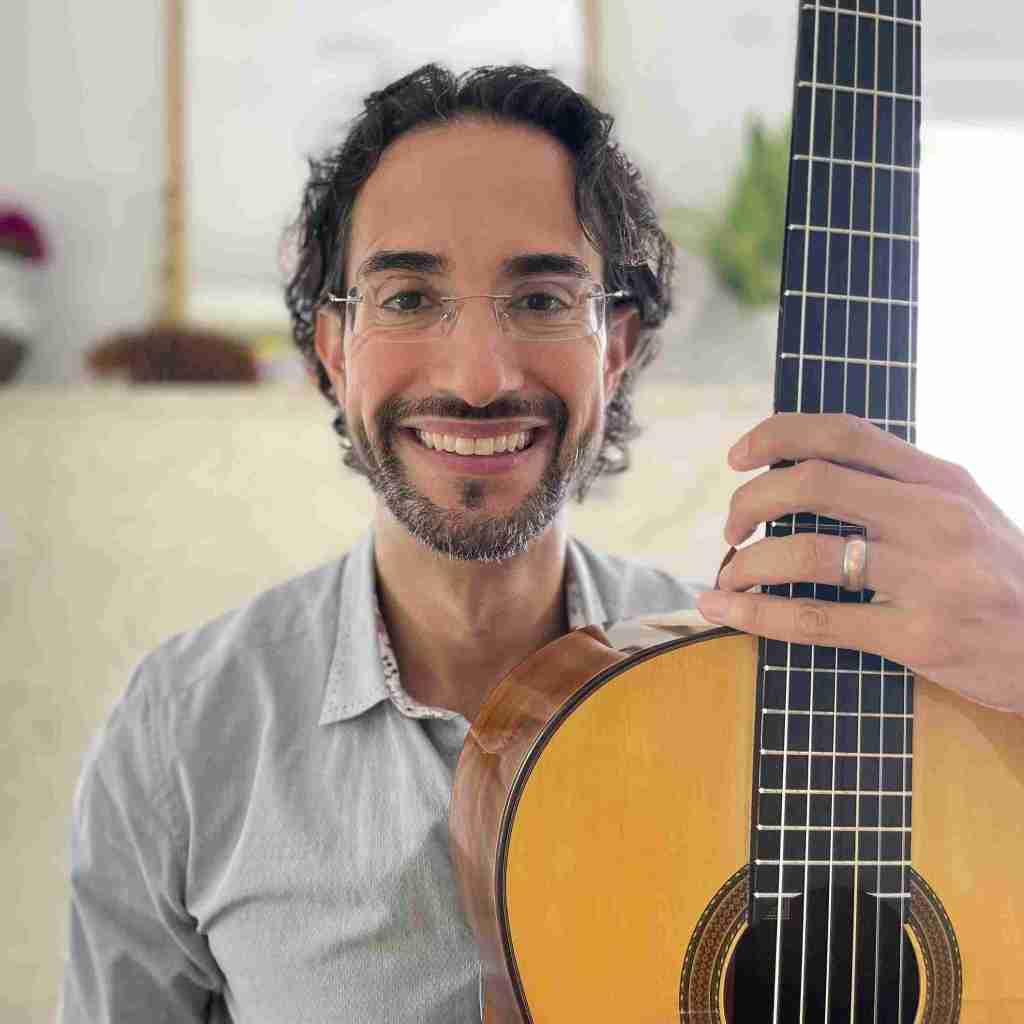

I’ve spent over 22 years working on scales/picados for both classical and flamenco guitar, and let me tell you – it’s been a journey! I’ve studied with masters, analyzed countless techniques, and spent thousands of hours practicing scales. The good news? I’ve figured out what actually works (and what doesn’t). Whether you’re trying to nail those blazing-fast flamenco picados or execute clean classical scales at 160 BPM, this guide will show you exactly how to get there without the frustration and injuries I dealt with along the way.
Table of Contents
How to Develop Lightning-Fast Scales for Classical and Flamenco Guitar
So you want to play lightning-fast scales? Let’s do it! 🎸
Whether you’re working on classical guitar scales or flamenco picado, the journey to speed requires patience, smart practice, and the right techniques. Let me break down everything you need to know.
The #1 Rule: Relaxation is Everything
Before we dive into technique, you need to understand this fundamental truth: stay as relaxed as possible.
Tension opposes progress!
The moment tension starts creeping into your movement, you need to eliminate it immediately. Only use as much muscular effort as needed to produce the speed and sound you want. Never, ever, EVER force your fingers to go faster than they can go or louder than they can play. This will result in tension, errors, a really bad sound, and eventually serious injury!
Here’s a mindset shift that changed everything for me: You’ll never be faster than you can relax. Speed isn’t about how fast you can force your fingers to move – it’s a result of how quickly you can relax between notes and while playing. That synchronization and relaxation speed is what determines your overall performance.
Keep this principle in mind as we explore scale technique. Everything else builds on this foundation.
Understanding Right-Hand Mechanics (Picado Basics)
Let’s start with the basics of what we’re actually doing with our right hand.
Right-Hand Fingering Options:
First and foremost, NEVER repeat fingers when playing scales or scalar passages that do NOT include slurs! Alternation is mandatory for proper scale technique.
Most guitarists alternate “i” and “m” (and vice versa), but you can also use “i” and “a” (and vice versa), or even “a-m-i” for a 3-finger alternation. It doesn’t matter as long as you’re always alternating your fingers, it feels comfortable and relaxed, and you’re producing the sound you want.
Rest-Stroke vs. Free-Stroke:
These two techniques produce different sounds, and understanding when to use each is important.
- Rest-strokes are played by briefly “resting” on the string just above the one you strike. This gives the note a more percussive and louder attack.
- Free strokes are played by passing (i.e., not touching) the string above the one you strike. Free strokes give the note a lighter attack with a little less volume.
And now, the confusing part. 🤔 In Spanish, the technique used to play scales and scalar passages is called a “picado.” The rest-stroke is called a “picado apoyando,” and the free-stroke is a “picado tirando.” Both are used in classical and flamenco, but the rest-stroke is predominant in traditional flamenco, whereas the free-stroke is common in classical. And…to make things confusing, the rest stroke is often referred to as simply a “picado” in flamenco guitar. Keep that in mind when you pick up a flamenco method book. If they say “picado,” they likely mean “rest stroke.”
Now, just because free strokes and rest strokes have their common uses in each genre doesn’t mean you have to be tied down to that. Using a free stroke or rest stroke in either genre is ultimately a personal choice that depends on the sound and volume you want to produce. Choose musically, not traditionally!
Hand Position and Finger Movement
Now that you understand the mechanics, let’s talk about positioning your hand for maximum efficiency and speed.
Basic Finger Movement:
- Most movement should come from the largest knuckle for most people, not the middle knuckle or the tip knuckle.
- Keep your fingers (including tip joints) loose and flexible — NO TENSION! 🚫💪🏽
- The exact directions of travel of the fingers are different for rest strokes vs free strokes.
Arm Positioning Secret:
You don’t have to keep your hand perfectly still and in one spot! As you move toward the bass strings, pull your elbow back, and as you move toward the trebles, move forward so that you don’t have to bend your wrist or reach too much to hit your target strings. That way, your finger angle stays relatively consistent.
Nail Considerations:
Make sure your nails are filed correctly and aren’t too long. Ultimately, nail length and shape are personal choices, but I prefer (and recommend) shorter nails because they allow for less resistance against the strings and still produce a good tone. If you’re unsure, start with shorter nails and experiment a bit.
The Secret to Speed: Relaxation & Synchronization
Now we’re getting to the heart of speed development. Relaxation and perfect synchronization are the secret weapons of all great guitarists.
Here’s what synchronization means:
When one finger goes down, the other prepares to rise & relax. These are two contrary movements that merge into a single motion. This synchronized play between fingers – one playing while the other relaxes – is absolutely crucial.
Managing Tension (The Right Way):
Certain movements (and speeds) require more muscle activation than others. That’s normal and acceptable. But tension, on the other hand, means using more muscle activation than needed for your task. The trick is knowing when you’re tense vs. when you are using the proper amount of muscle activation.
Here’s what you need to know:
At slower tempos, you can stay very relaxed. But as you increase speed, the key is to focus on staying relaxed while going for your current goal tempo. As soon as you notice tension, work on relaxing.
Let your intuition guide your technique a bit. Don’t intentionally restrict or force movement. Always operate under relaxation first. Then add only as much muscle activation as needed to reach your musical goals.
How to Build Speed Without Injury
Alright, you understand the technique fundamentals. Now let’s talk about actually getting faster in a smart, sustainable way.
Understanding Your Thresholds:
When trying to increase speed in practice, always look for your tension and error thresholds:
- As soon as you feel tension or start making mistakes, try to eliminate tension and correct errors
- If you can’t eliminate the tension or make corrections, slow down until you can
- Correct your mistakes at the slower speed
- Then try to increase speed again up to your threshold
- Keep repeating – gradually your threshold will increase
Realistic Expectations:
Reaching fast speeds (like 16th notes at 150-200 BPM) takes YEARS to achieve. Do not expect giant gains quickly. If you push yourself, you WILL get injured, and you WILL hit a wall quickly. I’ve seen a LOT of students make this mistake. Plus….I’ve been there too! 😵💫
As a very safe rule of thumb: Give yourself 30 days to increase your speed by 5 BPM. Progress isn’t linear, so you may increase more (or less) in 30 days. That’s okay as long as you are focused on playing tension-free and on your musical goals.
If one of your goals is to get really good at playing fast, clean, and musical scales, you need to practice them 5-6 days a week! But if you’re just playing for fun, 3 days a week is usually good enough. Just be consistent and smart in your practice. That’s what produces results!
So…How Do You Get Fast?
Well…there are tons of strategies you can use to increase your tempo, and no single strategy is necessarily any better than the others. But what IS important to understand is that any strategy may stop working at some point. And when that happens, you just need to switch to another strategy to continue improving. That’s completely normal and part of the process!
To find what works best for you, you can either do lots of trial and error to see what works or you can work with a music coach — like yours truly! 😉— to find which strategy you need now.
In the meantime, here are a few ideas you can try:
Start your practice at a slow and comfortable tempo (e.g., 60 BPM), then…
- Gradually increase tempo by 3-10 beats per minute with a metronome. When you hit your tension threshold, start clicking down by 1 BPM at a time until you can play relaxed and error-free
- Practice different rhythmic patterns (e.g., dotted 8th + one 16th, two 16ths + 8th, etc.)
- Try Note-Grouping (e.g., think “32nd note grace notes + a long target note”)
Quality Always Beats Speed
Here’s something crucial: Always focus on producing your best sound. Never prioritize speed or volume at the expense of your best sound.
Speed is important, but quality is paramount. Quality of sound and motion matters more than pure velocity. Every note should sound clear and powerful. Otherwise, you’ll sound like a blazingly fast, hot mess! Not pretty! 🤢
Non-musical Playing:
Don’t play every note with the same attack! Some notes call for a different sound than others in a scalar phrase. Before slamming into a scale, think about what you want your phrase to sound like and adjust your attack as needed.
This is what separates mechanical playing from musical playing. Speed with musicality is what we’re after!
Smart Practice Strategies
Now let’s talk about how to structure your practice for maximum effectiveness.
The Slow Practice Foundation:
Always practice slowly first. Slow practice is the absolute key to playing fast. This cannot be emphasized enough! Once you can play fluidly and musically at a slow tempo, then you can start speeding up.
Pre-Planning Movement:
Keep fingers close to the fretboard on your left hand and ALWAYS pre-plan your left-hand fingerings! Be efficient. Remember: The shortest way is the fastest way.
Breaking Down Scales:
- Start with a small chunk of notes (e.g., 1 beat of 16th notes)
- Gradually chain in more notes or beats (e.g., 1 beat plus 1 note or 1 beat plus another beat + 1 note)
- Practice both legato and staccato. Legato = long and connected notes. Staccato = short and disconnected notes.
- Practice playing quietly, loudly, and everything in between. In other words, make it musical!
This systematic approach helps you build speed and musicality in manageable pieces rather than trying to tackle everything at once.
Common Mistakes to Avoid
Let me save you from the mistakes I made (and that I see constantly in students).
Don’t Chase Speed!
Pushing yourself too hard to reach super-human speeds will result in injuries and plateaus. Instead, focus on reaching smaller goals in the present moment.
Simply work on improving — not necessarily “fixing” — something small in each practice session. Then celebrate your mini-win! Remember: Significant progress is the result of small and consistent improvements over time, not in one day! Be consistent!
Always Stretch:
Stretch before, during, and after practice. Why? It promotes relaxation and looseness on and off the guitar. Practice loose, dangling finger movements off the guitar to maintain that relaxed feeling.
Don’t Over-Practice Scales!
Most beginner and intermediate students spend waaaaay too much time playing scales. And, of course, there’s no single amount of time that works for everybody.
The answer ultimately depends on your goals as a guitarist, your experience level, your health, and individual differences. In general, my recommendation is that beginners should spend no more than 5-10 minutes on scale work/day, intermediates can go from 10-15 minutes/day, and advanced players 15-30 minutes/day. This is what I’ve seen work for most people, but of course, there are exceptions.
In all cases, I never recommend spending more than 5 minutes at a time on scales (or any technique). Save your hands and split it up! Work in sets where you interleave other techniques.
Monthly Goal Ideas:
- Increase max speed by 5 BPM
- Perfect one new scale pattern/month
- Practice actively reducing tension at all speeds
Long-term Perspective:
Remember, reaching speeds like 200 BPM takes years of consistent practice. That’s not discouraging – that’s realistic! Every master guitarist you admire spent years developing their technique. You’re on the same path, and every strategic practice session is progress.
Your Challenge This Week
This week, I want you to do two things:
- Record yourself playing scales at your current comfortable tempo. Listen back critically. Is your sound quality good? Is there tension? Are the notes even? Figure out how you can improve your sound and tension.
- Commit to slow and relaxed practice for the next 7 days. Resist the temptation to play fast. Focus entirely on quality, synchronization, and relaxation. Once you can do this consistently, you can start increasing speed gradually.
Want to Master Your Technique Faster?
Look, I get it – reading about technique is one thing, but actually implementing it and troubleshooting your specific challenges? That’s where things get tricky. You might be making mistakes you can’t even see, developing bad habits that’ll slow you down later, or just feeling stuck at a plateau.
That’s exactly why I created Spanish Guitar Mastery. Inside the program, I give you tons of personalized feedback on your technique, help you identify exactly what’s holding you back, and create a custom practice plan designed specifically for YOUR hands and YOUR goals. No more guessing, no more wasted time on techniques that don’t work for you.
If you’re serious about developing professional-level technique and want expert guidance every step of the way, click here to book a Free Consultation with me. We’ll identify your biggest technical challenges and I’ll show you exactly how you can work with me in Spanish Guitar Mastery to fast-track your progress.
Don’t spend years struggling with the same problems I did. Let me help you get there faster.
Happy practicing! 🎸
— Diego Alonso
P.S. The difference between guitarists who reach their speed goals and those who stay stuck? Consistent, smart practice with the right guidance. Don’t leave your progress to chance – let’s work together to make it happen!