

If you’re serious about how your classical or flamenco guitar sounds on stage you may already know how crucial a good DI box is. (And if you don’t, then keep reading!).
After 21 years as a professional guitarist with well over 3,000 performances behind me, I’ve personally tested hundreds of pieces of gear, including DI boxes. In this post, I’ll walk you through my top six picks for 2025 and explain why each one works (or doesn’t) for classical or flamenco guitar with pickups or microphones.

- 5-band EQ with low-mid and high-mid bans
- Chromatic tuner
- Adjustable volume boost footswitch
- XLR and 1/4″ outputs
- Phase inversion and notch filter (for feedback prevention)
This is my personal favorite and the DI Box I trust the most when performing with a pickup-equipped classical or flamenco guitar. It’s more than just a DI—it’s a full-featured preamp with a five-band EQ, notch filter, boost switch, and an onboard tuner that’s actually good. The EQ section is intuitive and the clean boost feature is a lifesaver for solos.
The Venue significantly reduces that harsh, brittle piezo pickup sound that makes your $3000 guitar sound like s**t, and instead adds a ton of warmth and presence to your sound. To be fair, no DI box will ever make your guitar sound totally natural like it would with a really good microphone. But when I need to plug in and want my guitar to sound as good as possible, the LR Baggs Venue is one of my top choices.
Pros:
- Excellent tone shaping with a 5-band EQ
- Clean boost and warm, but present sound.
- High headroom and ultra-quiet operation
- Extremely durability
Cons:
- Larger footprint than simpler DI boxes
- More expensive than basic models
- May be overkill for minimalist setups (but I think it’s worth it anyway)
2. LR Baggs Para Acoustic DI Box ($229)

- 5-band semi-parametric EQ
- XLR and 1/4″ outputs
- Phase inversion switch
- 9V battery or phantom power operation
- Ground lift switch
If you want practically the same awesomeness as the Venue DI but with less bells and whistles, this Para Acoustic is the way to go. This DI box has been a gold standard in the acoustic world for years, and for good reason. It’s compact, reliable, easy to use, and incredibly effective, especially if you’re looking to soften those plug-in mids and kill feedback. The EQ is also perfect for most performance situations. It gives you surgical control over your tone, which is especially useful for difficult rooms or sensitive PA systems.
The only “downsides” to the Para Acoustic is that it doesn’t come with a built-in tuner and it doesn’t have quite as much boost as the Venue. But it’s much more compact, easy to set up and use, and still gives you professional-grade sound. It also handles both microphones and pickups well, making it a great all-around choice for classical and flamenco players who need precision in a small package. When I know I won’t have too much time to set up for a gig, but still want the best sound I can get, the Para Acoustic is my go-to DI box.
Pros:
- Compact and portable
- Semi-parametric EQ offers precise tonal control
- Very affordable for what it delivers
- Durable and roadworthy
Cons:
- No tuner or boost function
- Less intuitive EQ layout for beginners
- Battery changes require unscrewing the back
3. Fishman Aura Spectrum DI ($469)
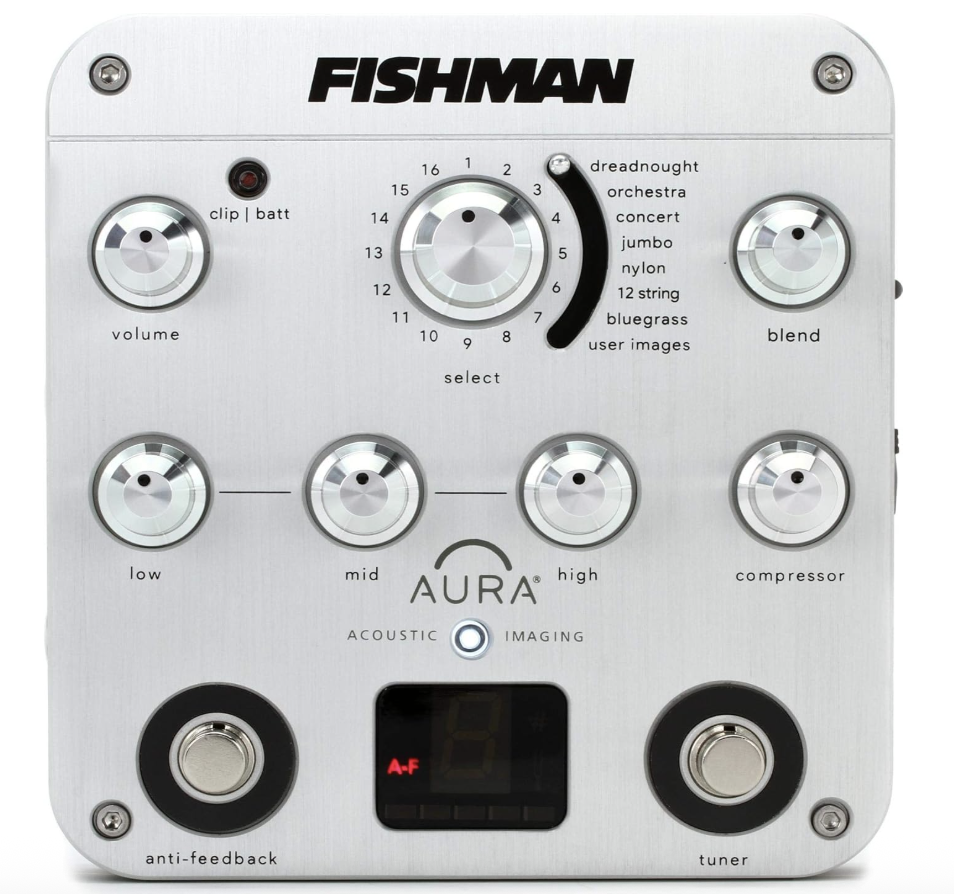
- Aura acoustic imaging technology
- 3-band EQ and one-knob compressor
- Built-in chromatic tuner
- Effects loop and XLR out
- 128 preloaded mic models
Ok…this one is pretty amazing! It’s not just an incredible DI Box; it’s also a sound “image blending” device that lets you combine your pickup sound with studio microphone profiles of real guitars. This can make your nylon-string tone sound more “real” and less like it’s coming from a piezo or magnetic pickup.
I find it particularly helpful when playing flamenco and classical plugged-in since the Aura uses the under-saddle pickups to emulate a mic’d tone without the feedback issues. That said, although it sounds amazing, it doesn’t exactly match the tone of my unplugged (or mic’d) guitars. I don’t think that’s really a downside, but it’s worth mentioning. The only real downsides are that there’s a bit of a learning curve on this one, the imaging takes some dialing in to get right, and the unit is a little pricey.
Pros:
- Image blend technology gives a more “mic-like” tone
- Built-in tuner, EQ, and compressor
- Excellent for players who dislike the sterile pickup sound
- Stores multiple instrument profiles
Cons:
- Complex setup for beginners
- Doesn’t work equally well with all guitars or pickups
- More digital than analog-sounding at times
- Slight learning curve to navigate features
4. Fishman ToneDEQ ($370)
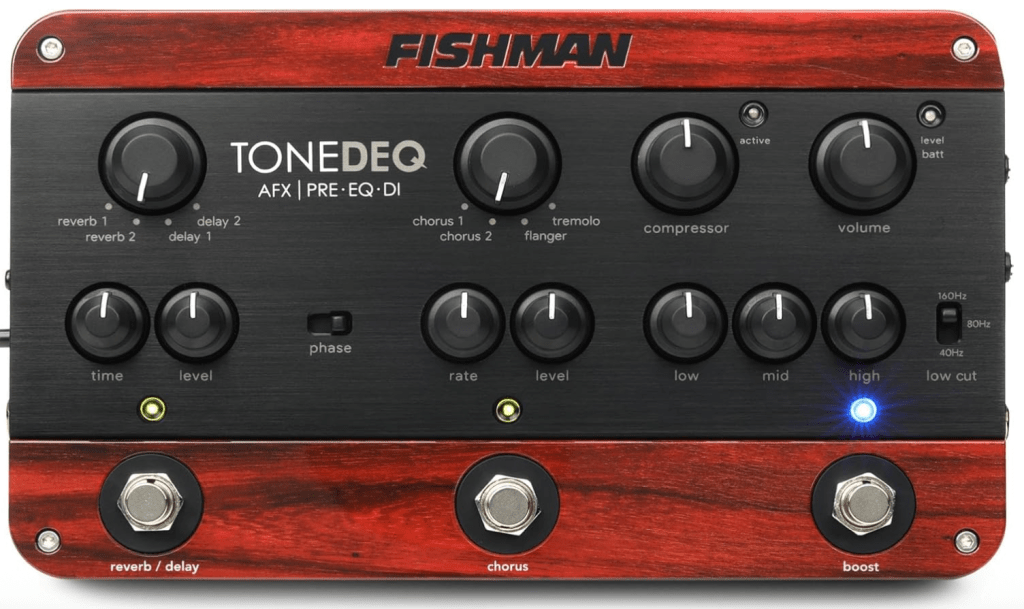
- 4-band EQ with sweepable mids
- Compressor
- Boost footswitch
- Effects (including reverb and a boost)
- Phase control
The ToneDEQ is a robust all-in-one DI with a strong feature set. You get a 4-band EQ, a compressor, effects, and a super clean and rich analog sound. It’s great for players who need to tweak their tone on the fly, especially if you’re using a mix of pickups and microphones. I particularly like the compressor feature when playing flamenco. Very helpful!
It’s a bit more transparent than the Aura and doesn’t include imaging, but it still gives you a musical, rich, and responsive tone. I’ve used it for larger venues where control over dynamics (thanks to the compression) was crucial and it was great!
Pros:
- Versatile feature set (EQ, boost, compression, effects)
- Good volume control
- Rich and clean analog sound
- It has reverb!!!! Yay!!!
- Solid build and layout
Cons:
- No imaging or IR features
- Slightly bulky
5. Fishman Platinum Stage EQ/DI Analog Preamp ($200)
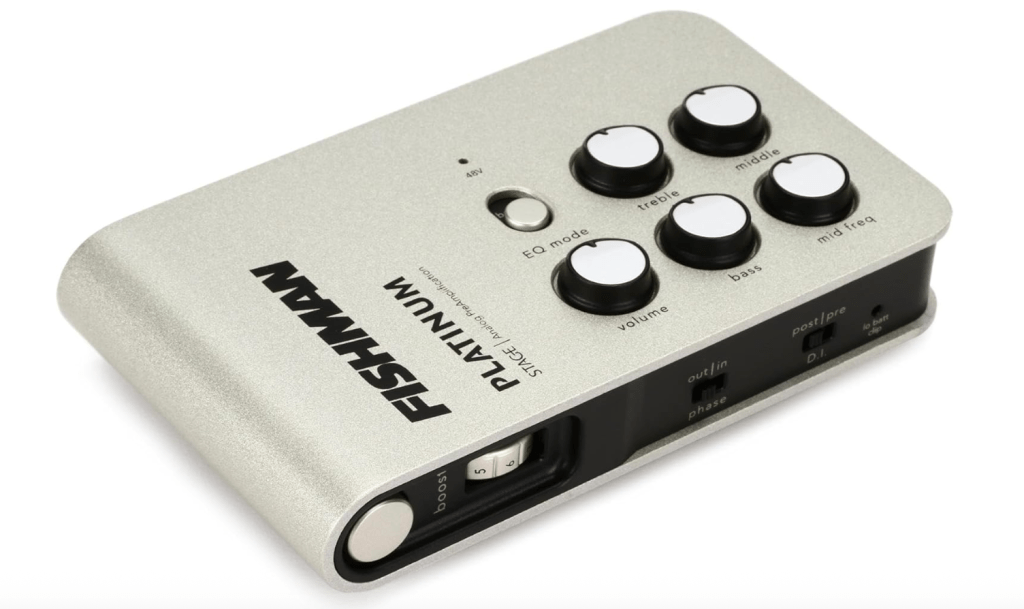
- 4-band EQ with sweepable mids
- Analog signal path
- Phase switch and volume control
- Belt clip for on-body use
- 9V battery or phantom power
Now, if you want a REALLY small footprint, the Fishman Platinum Stage EQ/DI is what you need. It’s a compact analog preamp with, surprisingly, plenty of punch for its size. It’s all analog, which I know some purists prefer, plus it has a volume control and really good four-band EQ with sweepable mids. And, for feedback control — because you WILL need this — it also a handy phase switch.
While it doesn’t have a tuner or compression, it still sounds warm and natural, making it a great option for smaller gigs or travel rigs where you don’t want to sacrifice tone.
Pros:
- Compact and very portable
- Natural, analog tone
- Simple and quick to dial in
- Affordable without feeling “cheap”
Cons:
- No tuner, boost, or compression
- No effects loop or advanced features
- Not ideal for large stage control
- Limited tone sculpting compared to others
Final Thoughts: My Top 5 Picks in Order
- ✅ LR Baggs Venue DI – The ultimate all-in-one DI for serious performers.
- ✅ LR Baggs Para Acoustic DI – Simple, reliable, and sounds amazing with nylon strings.
- ✅ Fishman Aura Spectrum – Great for a natural, mic-like tone from pickups.
- ✅ Fishman ToneDEQ – A flexible analogue DI for dynamic players.
- ✅ Fishman Platinum Stage EQ/DI – Best for small gigs or minimalist setups.
Learning Spanish guitar doesn’t have to take years. In my SPANISH GUITAR MASTERY COACHING PROGRAM, I’ll teach you a clear, structured approach that helps you improve faster using science-backed techniques and 20+ years of teaching and performance experience.
Subscribe to my Newsletter for more gear recommendations, expert practice tips, performance strategies, tutorials, and more!
The Links above are affiliate links. Although I have personally tried and recommend all of the items above, I also earn a very small commission from each of them. Commissions support my free YouTube channel and free educational blog. Please consider buying with the links above. Thank you for your support!