
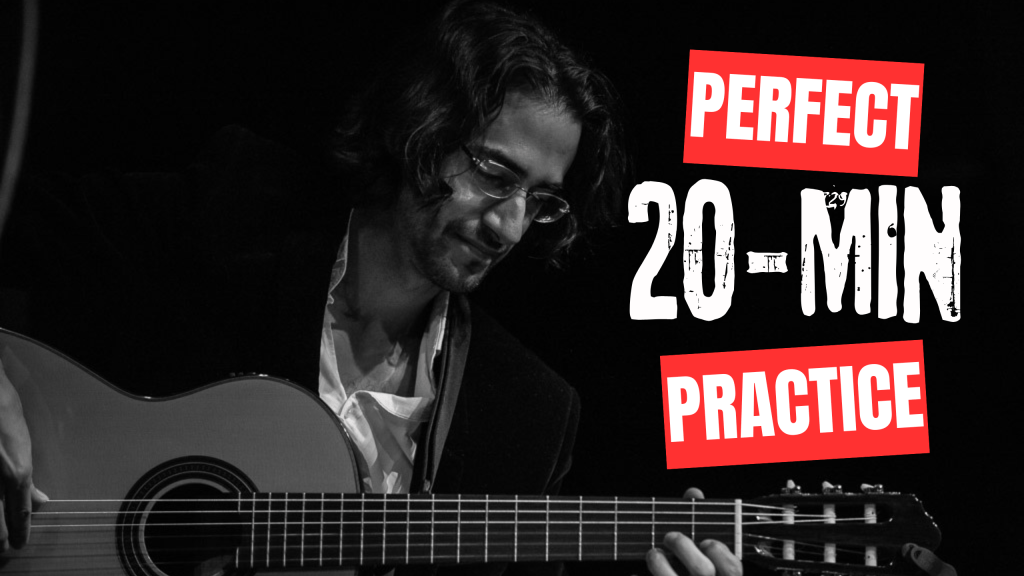
Between work, family, and everything else life throws at you, do you ever feel like finding time to practice guitar sometimes feels impossible?
Most students I talk to feel this way because they assume you need at least an hour of practice a day to make any progress. But that’s not true! I’ve seen students transform their playing with just 20-30 minutes a day of consistent practice.
Since you’re on my newsletter, you’ve likely heard me and probably tons of other people say something like, “It’s not about how long you practice – it’s about how smart you practice.” Well, there’s a ton of truth in that. So I wrote this quick guide for all of you super busy people with only 20 minutes of practice time available.
In this blog post, I’m going to show you how you can maximize your gains in the practice room with just 20 minutes a day! Check it out
Table of Contents
- Why 20 Minutes Is Enough (If You Do It Right)
- The Science Behind Effective Practice
- Your 20-Minute Practice Breakdown
- Section 1: Warm-Up (2-3 Minutes)
- Section 2: Technique Work (4-5 Minutes)
- Section 3: Repertoire Development (10-12 Minutes)
- Section 4: Performance Practice (2-3 Minutes)
- The #1 Mistake Busy Guitarists Make
- Your 20-Minute Practice Plan Template
- Caveat
The 20-Minute Guitar Practice Plan for Busy People
Why 20 Minutes Work (If You Do It Right)
Here’s something that might surprise you: research shows that, for most people, practicing for more than 2 hours can actually make you worse! 😲 Yup, it turns out that for a large majority of us, our brains literally can’t absorb information effectively beyond the 2-hour mark, mostly because we get brain-fatigue and can’t concentrate at a very high level for so long.
The people who can go past 2 hours a day and make significant progress are usually extremely high-level musicians who started playing before they were born! 🤔 And even still, 3 hours was the average maximum total practice time even for them!
More practice isn’t always better. What matters is focused practice. I’m talking about deliberate, strategic practice where every minute counts. Not mindless repetition while you’re thinking about what’s for dinner or while watching TV.
And I know you can focus for 20 minutes! So if you’re avoiding practice because you “only” have 20 minutes… You’re missing a quick chance to make significant progress. Twenty focused minutes beat 60 unfocused minutes every single time.
The Science Behind Effective Practice
Here’s something really cool from performance psychology research. Scientists studied piano students learning a tricky three-measure passage from a slightly challenging piece of music. Some students practiced for almost an hour. Others finished in less than 10 minutes.
Which group do you think did better?
(drum roll……)
Neither! Practice time had zero impact on who played it best the next day.
Here’s what did matter: The students who had more correct than incorrect repetitions performed better. Not the ones who put in more hours. Not the ones who did more total reps.. The ones who focused on quality over quantity and focused on minimizing incorrect repetitions.
Here’s what the top performers did in practice:
- They identified the exact location and cause of each mistake.
- They stopped to fix every error immediately instead of plowing through or starting over.
- They varied their tempo strategically by slowing down right before challenge spots (CSs) and then speeding up a little to test themselves after correcting the CS.
- They repeated their phrases until each error disappeared completely.
This is exactly why mindless repetition doesn’t work. You know what I mean – playing through a piece until you hit a mistake, stopping, playing it again, hitting the same mistake, getting frustrated, and repeating this cycle until you want to throw your guitar out the window 😵💫.
That’s not practice. That’s just reinforcing mistakes (or creating new ones)!
Your 20-Minute Practice Breakdown
When I practice, I usually do so for about an hour and work in 15-20 minute chunks (plus breaks). Each chunk is dedicated to a specific musical goal I have for that practice chunk, and I always make progress in each 20-minute chunk! So I know first-hand that you can make progress in 20 minutes!
That said, let’s build your 20-minute practice session. We’re going to divide it into four sections, and each one has a specific purpose.
Section 1: Warm-Up (2-3 Minutes)
Yes, just 2-3 minutes! This isn’t about getting a workout in – it’s about waking up your hands and brain.
Your warm-up should include three super basic elements:
- Right-hand contraction movements (e.g., simple arpeggios)
- Right-hand extension movements (e.g., simple rasgueados)
- Left-hand coordination exercises (e.g., easy scales or slurs)
The most important thing is to keep your physical effort LOW. These exercises should be extremely easy – something you can do at a medium to fast tempo (for you) without strain or mistakes.
Your mental effort, on the other hand, should be HIGH in terms of focus. Concentrate on these:
- The quality of sound you’re producing
- Minimal physical effort in your movements
- The speed and efficiency of your technique
I know this is just the warm-up, but the point isn’t just to move your fingers around. Every note you play, even in warm-ups, should sound musical and pleasant. Technique for technique’s sake leads straight to mistakes, bad sound, and boredom!
Section 2: Technique Work (4-5 Minutes)
This is where things get interesting. You’ve got 4-5 minutes to work on ONE specific technical challenge that shows up in your repertoire.
Not five different techniques. Not a million scales. ONE thing. And your goal is to improve it!
Here’s a perfect example: Let’s say you’re working on Recuerdos de la Alhambra and your tremolo sounds uneven. Don’t spend these 4 minutes playing through the entire piece. Instead, isolate just the tremolo pattern on open strings. Work on getting that a-m-i pattern perfectly even.
Research on music students found that the best performers set specific goals before each practice attempt. Not vague goals like “play it better” or “use good technique.” Specific ones like “keep my thumb relaxed” or “make sure the ‘i’ finger matches the volume of ‘a’ and ‘m’ fingers.”
Here’s your strategy for these 4-5 minutes:
Before each repetition, ask yourself: “What exactly am I trying to fix or improve this time?”
After each attempt, play detective. For example, “Did the ‘i’ finger still sound quieter? Why? Was my finger angle off? Did I use less physical effort?”
Then make ONE adjustment and try again.
This is what separates effective practice from wasting time. You’re not just repeating mindlessly – you’re experimenting, analyzing, and correcting with surgical precision.
And here’s a REALLY important point that a lot of students forget to do: if something’s not working, SLOW…IT….DOWN.
Remember the top performers in the practice time study I mentioned? They slowed things down right before challenge spots. This let them coordinate the correct movements at a tempo they could handle, instead of repeatedly failing at performance tempo and reinforcing mistakes.
If you’ve read any of my other blog posts on effective practice, you’ll remember that playing something wrong ten times and once correctly isn’t progress. It means you’ve got a 90% chance of making a mistake next time! 🤯.
Section 3: Repertoire Development (10-12 Minutes)
This is your biggest chunk of time, and for good reason. This is where you actually learn music you want to play!
Pick ONE piece (or one challenging section of a piece). That’s it. Don’t try to work on five different pieces or phrases in 10 minutes. Your brain literally can’t process that effectively.
Your mission: learn it slowly, play it smoothly, memorize it, and push yourself just a little.
Here’s your approach:
Minutes 1-2: Map it out
Look at the passage. Don’t even play yet. Can you identify possible challenges? Any tricky fingerings? If you can’t see it, play/stumble through it once and mark every single challenge you identify in your music or on a sheet of paper. Then pick ONLY 2-3 challenge spots to work on for your practice session.
Minute 3-8: Problem-solve like a scientist
Work through each challenge spot systematically. And I mean really work through it. Your goal here is to problem-solve and improve.
Let’s say you’re learning Guajiras de Lucía (by Paco de Lucía) and keep missing a position shift in the second scale. Don’t just play the second scale from the top, over and over, hoping it gets better.
Instead, try this:
- Isolate just the shift. Try 2-3 notes before + the shift + 1-2 notes after
- Play it correctly twice at a very slow tempo.
- If that went well, play it correctly 2-3 times in a row a little faster.
- If that went well, play it correctly 2-3 times in a row, a tiny bit faster.
- Only then, add the surrounding measures back in
Research shows that the more INCORRECT reps you play the worse off you’ll be. Your goal should be to play as few incorrect reps as possible, and maximize your correct reps. That increases your success rate, builds confidence, and solidifies correct muscle memory.
Minutes 9-12: Connect the dots
Now play larger sections, incorporating your fixed CSs. Still slowly! If you can play it perfectly at 60% of our final tempo, that’s winning. Speed will come naturally once the movements are correct and relaxed.
Remember: tension opposes progress. The moment you feel tension creeping into your shoulders, jaw, or hands – STOP. Take a breath. Reset. Tension means you’re working too hard or too fast. Remind yourself to play with minimal physical effort.
Section 4: Performance Practice (2-3 Minutes)
This is where you finally get to just play and enjoy yourself! This is your reward for working hard in your strategic practice. 🎸
Pick something you already know pretty well – maybe a piece you learned last month, or even just a polished section of what you worked on today.
Here’s the important mindset shift: you’re not problem-solving anymore. You’re performing. This means you’re going to brush mistakes off as if you were walking down the street and stumbled. Just keep going and focus on your goals!
Play your piece/phrase from start to finish WITHOUT STOPPING. No matter what happens.
Missed a note? Brush it off and keep going. Tempo wobbled? Keep going. Don’t stop for anything!
Here you want to focus on these things:
- Playing with as much musical expression as possible. (Think dynamics, tone, tempo, phrasing, etc.)
- Really connecting to your music! Be fully immersed in the present moment.
- Truly enjoying the sound you’re creating.
- Staying relaxed.
This is the first step to building performance confidence. Because we can’t develop stage-ready skills if we always stop and fix every little mistake in practice. We need to train ourselves to keep going, to stay musical even when things aren’t “perfect.” We need to trust your preparation and remember why we’re playing music: for fun and expression, not technical perfection!
And if you want to up your game even more, record yourself. Even just an audio recording on your phone. You don’t have to listen to it right away (I know, listening to ourselves can be cringey), but it’s incredibly valuable for identifying what needs work in tomorrow’s strategic practice section.
The #1 Mistake Busy Guitarists Make
You know what the biggest mistake busy guitarists make? Thinking that because you only have 20 minutes, you need to cram everything in and practice as fast as possible.
Please don’t do that! That’s like going to the grocery store when you’re starving and just throwing random stuff in your cart until it overflows. 🤔
The research is crystal clear on this: elite performers do fewer repetitions than intermediate players in the same practice time. But each repetition is more focused, more intentional, and more effective.
They spend more mental energy planning what they’re going to do. They think before they play. They analyze after each attempt.
Meanwhile, less effective practicers just… play. A lot. Without much thought. It feels productive because you’re busy and your fingers are moving, but your brain isn’t really learning anything new.
Here’s another crucial insight from the research: intermediate players tend to work on stuff they’re already good at. It feels good, right? You sound awesome playing that easy piece!
But elite performers spend most of their time on their weakest skills. It’s less fun – I know – and it requires more mental effort, but that’s where the growth happens!
Your 20-Minute Practice Plan Template Recap
So, here’s an easy routine to follow. Feel free to tweak it as needed.
Warm-Up: 2-3 minutes
- Right-hand contraction exercise (1 minute)
- Right-hand extension exercise (1 minute)
- Left-hand slurs or simple scales (1 minute)
- Stay relaxed, focus on beautiful tone
Technique Work: 4-5 minutes
- Choose ONE challenging technique that appears in your current repertoire
- Set a specific goal before each attempt
- Slow down CSs (challenge spots)
- Fix errors immediately
- Aim for 5-7 correct reps in a ROW for every error.
Repertoire Development: 10-12 minutes
- Work on ONE piece or section
- Identify 2-3 CSs (2 minutes)
- Systematically fix each CS (6-8 minutes)
- Play through slowly, connecting all the parts (2-4 minutes)
- Prioritize correct movements over speed
Performance Practice: 2-3 minutes
- Play something you know well, start to finish
- NO stopping for mistakes
- Focus on musicality and expression
- Enjoy yourself!
Consistency Is Everything
Is 20 minutes really enough? Yes, it is, but it only works if you actually do it consistently. Three times a week minimum. Preferably five or six days.
If you can do more than that consistently, using the strategic practice approach I described, of course, you’ll improve way faster. But 20 minutes a day is an awesome start!
If you’re new to structured practice, don’t go crazy! Just start with exactly 20 minutes and don’t push beyond that. Your body needs time to adapt. Add 5 minutes per week if you want to gradually increase, but there’s no rush.
I’ve had students make incredible progress with just 20 minutes a day, five days a week. The key isn’t the time – it’s the consistency and the quality of that time that matters most.
Ready to Transform Your Playing?
Here’s what I know after teaching over 23,000 lessons: the guitarists who progress fastest aren’t the ones with the most time. They’re the ones who practice most strategically.
And if you’re someone who wants to accelerate your progress even faster with personalized guidance? That’s exactly what I created Spanish Guitar Mastery for. Inside SGM, you get weekly masterclasses where I break down exactly what to practice and how, individual coaching where I analyze your playing and give you custom solutions to your specific challenges.
Imagine having a practice plan that’s tailored specifically to YOUR goals, YOUR struggles, and YOUR available time. No more guessing whether you’re practicing the right things. No more frustration, wondering why you’re not improving faster.
The next SGM program begins after January 5, 2026! And….there are only 10 spaces left because I work personally with each student. Click here to book a free consultation with me at https://calendly.com/diegoalonsomusic/free-consultation and let’s create your personalized roadmap to breakthrough results.
P.S. Set a timer for your next practice session. You’ll be amazed at how much more focused you become when you know every minute counts.
P.P.S. Check out articles you may have missed at https://diegoalonsomusic.com/blog/