The Difference Between Classical And Flamenco Guitar Music
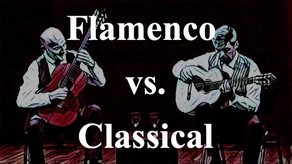
One of the first questions people ask me is “What’s the difference between flamenco and classical guitar?” The question refers to both the music and the instrument construction but today I’m only going to focus on the former. Next week I’ll talk about the construction.
We also have other resources on gear that enhances your guitar experience. You can explore our detailed guide on the best Classical and Flamenco guitar amplifiers to find the right sound for your playing.
THE MUSIC
In general, there is a clearly noticeable difference between the musical composition and the resulting sound of classical and flamenco guitar. The 5 most significant musical differences that pop out to me are counterpoint, attack, strumming, harmony, and styles.
Counterpoint, which is 2 or more lines of music with different melodies and rhythms, played simultaneously by one instrument is very common in classical guitar (e.g., 1). Flamenco guitar, on the other hand, tends to be more linear musically (e.g., 2).
The second difference is the attack on the strings. Traditionally and generally speaking, classical guitarists tend to play with a lighter attack (e.g., 3) than flamenco guitarists (e.g., 4). However, this has also become a personal preference in recent years. There are plenty of guitarists from both genres that attack the strings using a wide range of options.
The third difference has to do with strumming (“rasgueados”). In general, most classical guitar does not include strumming. Some notable exceptions are Spanish composers, like Rodrigo and Turrina. Flamenco guitar on the other hand almost always includes some amount of rasgueados in virtually every composition.
The fourth difference has to do with harmony. Eighty percent of flamenco music is written in the Spanish Phrygian mode and uses its respective Andalusian cadence. And the last 20% of flamenco is traditionally written in both major and minor keys. Classical guitar is more expansive and utilizes major and minor keys along with the major modes and plenty of key changes (modulations).
Finally, flamenco music has a codified set of styles within which all of its music is written — there are roughly 5 families of flamenco music with over 50 styles within and across these families. Classical guitar is, again, more expansive compositionally and is written without limits to style, meter, rhythm, or harmony.
Naturally, there are always exceptions. There are classical pieces that sound, flamenco (e.g., Asturias) and flamenco pieces that sound classical (e.g., Percusión Flamenca). And, as time passes both classical and flamenco guitarists and composers explore and borrow elements from each genre.
I hope this quick comparison helps you understand the difference between both styles and inspires you to explore a bit more of both.
Additionally, if you’re looking for the best protection for your instrument, I’ve got you covered with a list of the top-rated cases for Classical and Flamenco guitars.
To learn about the difference between the construction of the Flamenco in classical guitar, check out this article I wrote too.
Finally, for those seeking precision in tuning, be sure to check out my recommendations on the most reliable capos for your Classical and Flamenco guitars.
Happy Practicing!
—
Diego