
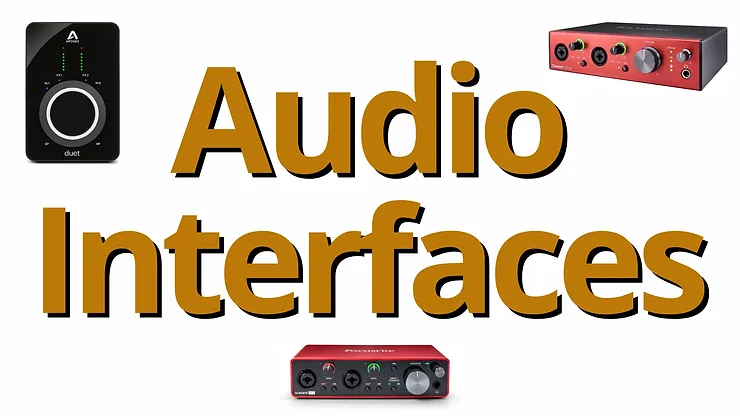
As a professional classical and flamenco guitarist with over 21 years of experience, I’ve tried a LOT of audio interfaces for recording at home. Here are my 3 top audio interfaces for acoustic instruments for 2025.
(*Please consider buying with the affiliate links below to support my free education blog and YouTube channel.)+
PROFESSIONAL TOP AUDIO INTERFACEApogee Duet 3, 2-Channel USB ($649)
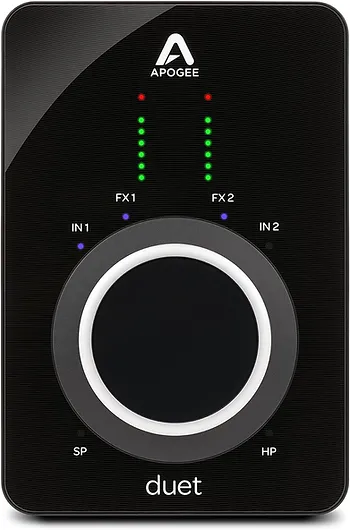
- Mic Pre: Gain up to 65dB
- 48V Phantom power for each channel
- Up to 24 bit / 192kHz recording
- 2×4 USB-C audio interface
- 2 USB Type-C Ports
- 2x ¼” Instrument input
- 2x ¼” Balanced outputs
- 1/8” Headphone output
- Bus-powered
- On-board hardware DSP for low-latency recording with Apogee FX
REVIEW
To date, Apogee has always been my favorite audio interface for studio recording. I had the Duet 2 for years and immediately upgraded to the Duet 3 as soon as it came out. This interface delivers an unbeatable sound because of its pristine A/D (analog to digital) and D/A (digital to analog) conversion. As a classical or flamenco guitarist, the cleanliness of sound from an audio interface is paramount, which is the main reason I chose the Duet as my favorite interface. It also has onboard DSP (digital signal processing) hardware which lowers the latency to zero when monitoring.
In terms of quality, the 2 pre-amps are high-end studio quality which, again, results in pristine sound. This is the kind of interface you can use with any kind of mic and get the best sound possible. And since the Duet supplies 48V of phantom power in each channel, that means I can easily use my Neumman KM184 when recording guitar. My only 2 complaints are quite minimal: 1) it’s a bit hard to see the display lights and, 2) the Duet 3 is on the pricey side.
Final thoughts: If you need the best possible, studio-quality interface that allows you to record 2 channels simultaneously, the Apogee Duet 3 is absolutely the way to go.
PROFESSIONAL AUDIO INTERFACE - RUNNER-UP Focusrite Clarett+ 2Pre USB-C ($442)
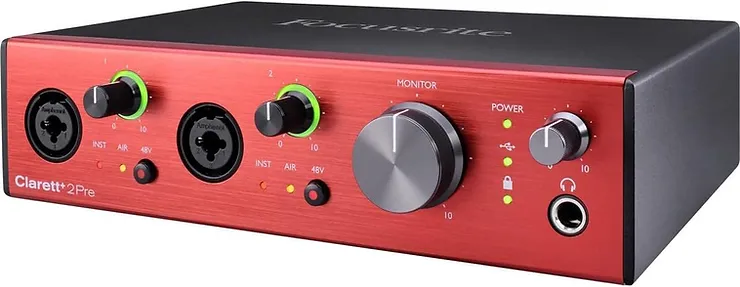
- 2 Line-in channels: XLR or 1/4″
- Mic input up to 18dBU
- Max gain of +57dB
- USB-C Powered
- Low distortion, 24-bit/192 kHz converters with up to 124dB dynamic range.
- 4 Outputs
REVIEW
I really love my Apogee Duet 3 (above), but when I used this Focusrite Clarett, I was surprised at how amazing the sound was. Like the Duet, this Focusrite also has 2 studio-quality preamps built in plus the option to use “Air mode” which makes the Clarett sound almost identical to the Duet 3 in terms of clarity and presence. It’s super easy to use and the lights on the front are very clear.
This interface also offers 48V of phantom power for each channel making it ideal for recording with premium condenser mics as well as dynamic mics. Like the Duet, this interface also has pristine A/D & D/A hardware built in and tons of headroom (if needed). My only 2 critiques — and these are really minimal — are 1) I’m not crazy about the software and 2) I don’t particularly like the inputs in the front but this realy just a personal choice that doesn’t affect the quality of the interface.
Final thoughts: If you want a truly excellent audio interface that won’t break the bank, get the Focusrite Clarett+ 2Pre.
BEGINNER AUDIO INTERFACEFocusrite Scarlett 2i2 4th Gen ($199)

- 2 Channels: 1/4″ & XLR
- USB-C Powered
- 69dB of gain
- 120dB dynamic range
- Auto Gain and Clip-Safe modes (to prevent clipping)
- “Air” mode to model higher quality preamps.
REVIEW
This (very) small audio interface is an amazing choice for beginners and intermediate home-studio producers who want more of a plug-and-play experience. The 4th Gen upgrade from the 3rd Gen model offers a huge 120dB dynamic range and up to 69dB of gain, allowing for a much cleaner sound from yor acoustic instruments. It’s very easy to use and, like all Focusrite interfaces, offers its analogue “Air mode” which boosts clarity and presence closer to studio quality. My only 2 critiques: 1) the XLR inputs are in back and 2) it’s a bit too light for my taste which makes it move around on my desk easily. That said, if you’re starting out, and don’t want to mess around with a steap learning curve, this is the interface to get.
Choosing between styles is part of every guitarist’s journey. If you’re wondering how they differ, this guide on Flamenco and Classical Guitar offers clarity to help you move forward with confidence.
No matter which path speaks to you most, my Spanish Guitar Mastery Coaching Program is here to guide your progress with a clear, structured approach.
The Links above are affiliate links. Although I have personally tried and recommend all of the items above, I also earn a very small commission from each of them. Commissions support my free YouTube channel and free educational blog. Please consider buying with the links above. Thank you for your support!